
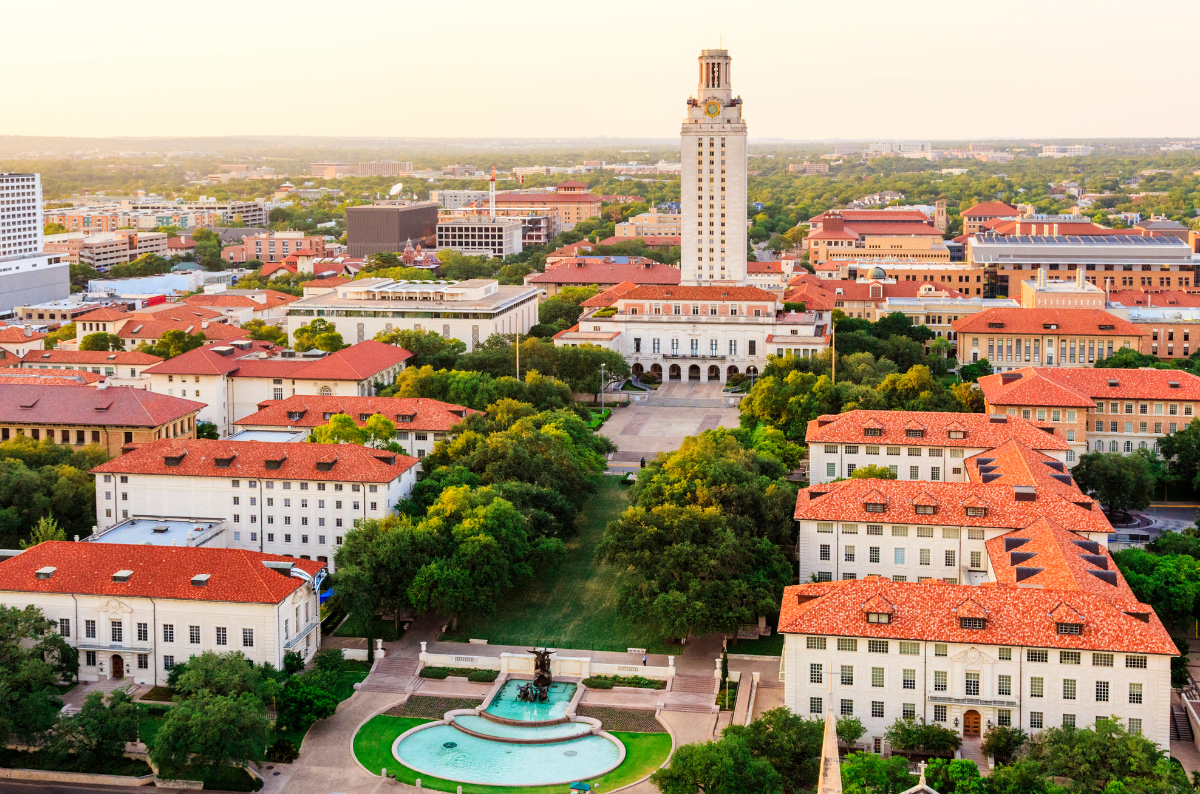
The University of Texas at Austin is a popular choice for students from Texas and beyond. Admission to the university is highly competitive, with admit rates for some majors in the single digits. Understanding how the university evaluates applicants, what automatic admissions (“auto admit”) means, and why “fit-to-major” starts early in high school is important.
Consider these the key points high school students and parents should understand when considering UT Austin.
Admissions Landscape
UT Austin admissions continues to change! I guide many UT Austin applicants whose parents are alums who find it hard to believe UT is so ultra-competitive, especially UT Austin’s fanatic emphasis on “fit to major.”
Application numbers increase each year: 51,000 pre-pandemic, now 100,000+ expected each year. About 80% of accepted students are auto-admit, and they are in the top 5% of their Texas high school class. Caveat, though: Auto-admit guarantees Liberal Arts majors admission only, not McCombs School of Business, Cockrell School of Engineering, College of Natural Sciences (CNS), or other competitive programs. For non-auto-admit applicants, the overall acceptance rate was 7% for the high school class of 2026.

What is Meant by Fit-to-Major?
For UT Austin applicants, fit to major is a key factor, along with a strong academic profile and high test scores. The applicant’s academic AND extracurricular profile must align with the intended major.
While the college application shows a second choice major option, this only matters for auto-admit students; non-auto admits will not be considered for a second choice major.
Fit to major should be evident through every application component: essays, resume, transcript, recommendations, test scores. For the super competitive majors, fit is of utmost importance: computer science, engineering, business, nursing, natural sciences, economics, psychology. For those majors, excellent grades in rigorous coursework show academic preparation and competitiveness; a resume should feature activities related to the major, emphasizing initiative, depth, leadership, and commitment. Students considering these majors should also apply to other schools and keep their list broad.
If a student has a UT-or-bust mentality but is not a strong applicant for highly selective majors, or not an auto admit, the student should weigh the choice of major strategically. Less competitive majors are available, but the student must still show fit for the major.

GPAs and Test Scores
The weighted GPA and course rigor are the two most important academic signals for non-auto-admits. If a student is applying for a quantitative major, calculus is essential, preferably before senior year.
UT Austin requires test scores from either the ACT or the SAT. Best test date only; no superscoring.
Essays, Resume, and Recommendations
For the current application cycle, there are two required supplemental essays:
Why This Major?
Describe an Extracurricular Activity You’re Most Proud of and Why
Both essays are opportunities to highlight fit to the major, but in different ways.
The expanded resume is unique to UT. It’s a detailed document like no other you’ll ever create. Certainly employers won’t want a resume in this style. The resume should highlight genuine experiences that demonstrate curiosity, initiative, relevant skills, and sustained engagement. Impact and depth are key.
UT Austin has a strong preference for non-academic recommendation letters. UT values perspectives from those who know students outside the classroom. Keep in mind: FIT TO MAJOR. So, choose recommenders from activities that you are deeply involved with that align with your major.
Extracurricular Strategy
Some questions to consider as you plan your extracurricular activities:
What are your genuine interests? Can you articulate what you find interesting about the subject?
Is there depth? Are you investing time, developing skills, taking initiative, and growing in responsibility?
What is the evidence of your engagement? Have you created something, solved a problem, contributed to a team, served others, or pursued a question?
As you reflect on the experience, can you explain how it shaped your thinking and/or influenced your interest in your major?

Extracurricular Suggestions*
Engineering, Computer Science & STEM
Participate in robotics, coding, engineering, or science clubs.
Build an independent project, app, website, or prototype.
Conduct research through a school program or a mentor, when available.
Tutor math or science, or participate in science fairs and technical competitions.
Start a STEM club at a local elementary school.
Business, Finance & Economics
Participate in DECA, FBLA, or an investment or economics club.
Develop a small business or manage a real project budget for a non-profit or extracurricular school activity.
Analyze a business problem or research an economic issue.
Work in a job involving sales, customer service, accounting, or operations. Plenty of fast food and retail operations to choose from.
Biology, Public Health & Pre-Health Interests
Volunteer with a community health organization, clinic, or local hospital.
Explore health sciences through elective coursework or educational programs.
Participate in biology research, science outreach, or health education projects.
Take on a sustained community service role addressing a health-related need.
Communications, Journalism & Media
Write for the school newspaper or literary magazine.
Produce a podcast, documentary, newsletter, or multimedia project.
Manage communications or social media for a student organization.
Interview community members or report on a local issue.
*Note: suggestions only, not the definitive lists for assured admissions

Four-Year Roadmap
The road to becoming a strong UT Austin applicant starts early in high school.
9th and 10th grades: take career assessments, explore potential majors including identifying academic preparation for these, seek learning experiences related to the major(s), begin initiating activities, use summers for major-aligned, in-depth opportunities
11th grade: focus on leadership, deep commitment to major-aligned activities, community impact tied to major, identify non-school recommenders
12th grade: persist with leadership, reflect on your experiences before you begin writing your essays, ensure your college list is balanced beyond UT
Each year: rigorous coursework, career-related experiences, informational interviews, shadowing to affirm major/career, document your experiences for future reference.
To learn more about me or my services, visit my website.
For the latest tips and advice, be sure to follow along on my social media.